What Is the FERS Supplement?
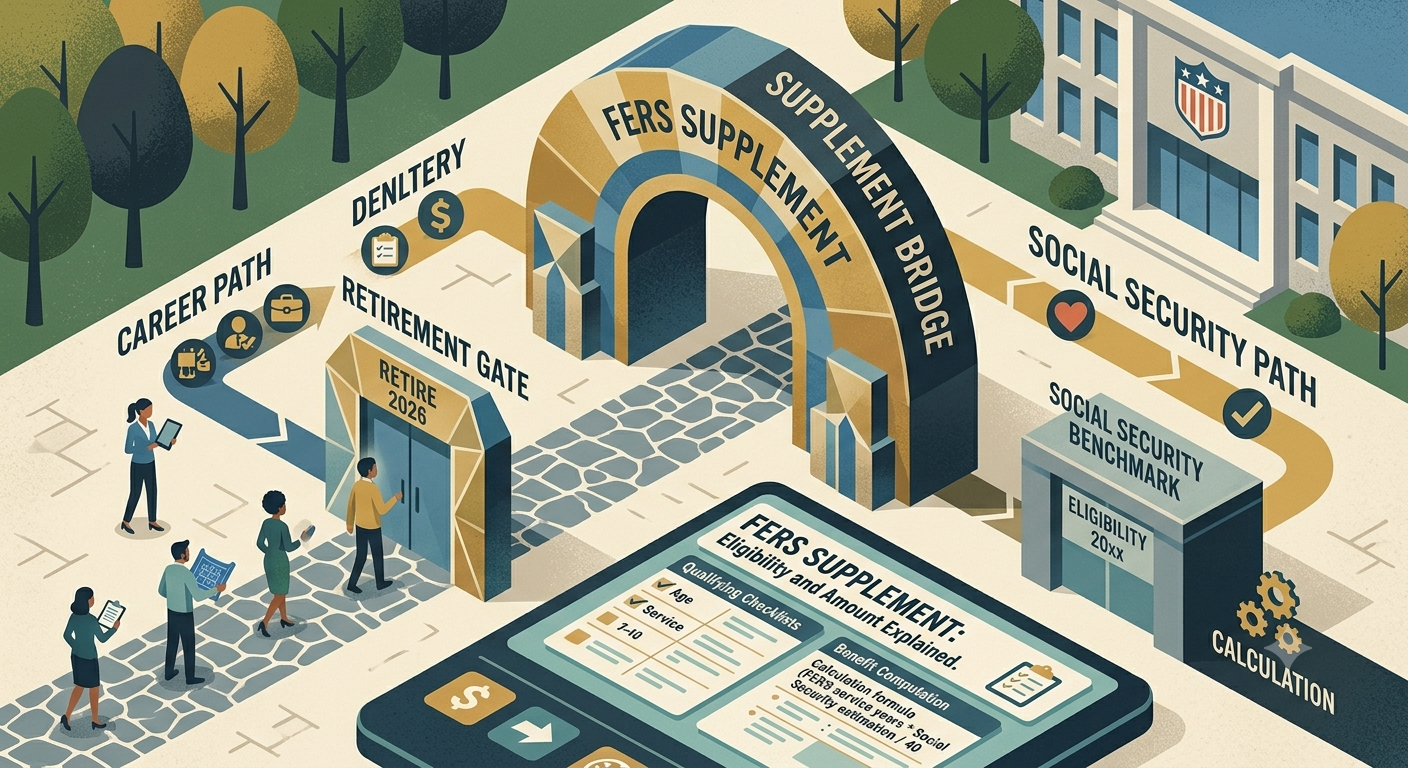
The FERS Supplement, officially called the Special Retirement Supplement, is a monthly payment designed to bridge the income gap for federal employees who retire before they’re eligible to claim Social Security at age 62. It’s paid by OPM alongside your regular FERS pension, and it’s meant to approximate the Social Security benefit you would have earned from your federal service, until you become eligible to claim Social Security itself.
In simple terms: the FERS Supplement exists because retiring under FERS before 62 means retiring with only two of the three «legs» of your retirement (pension and TSP) actively paying out — the supplement helps fill that gap until Social Security kicks in.
Who Qualifies for the FERS Supplement?
Not every FERS retiree receives this benefit. Generally, you qualify for the FERS Supplement if you meet one of these conditions:
- You retire at your Minimum Retirement Age (MRA) with 30 years of service, or
- You retire at age 60 with 20 years of service, or
- You’re involuntarily separated (before your MRA) and meet certain age and service requirements, or
- You retire under certain special provisions categories (law enforcement, firefighters, air traffic controllers) that have their own mandatory retirement ages.
Importantly, employees who take a deferred retirement (leaving federal service before meeting immediate retirement eligibility, then starting their pension later) generally do not qualify for the FERS Supplement, even if they eventually start their pension before age 62.
How Is the FERS Supplement Calculated?
The FERS Supplement is calculated using a formula based on your estimated Social Security benefit at age 62, prorated by your years of federal service (not your total years of work, including any private-sector employment).
The simplified formula looks like this:
$$\text{(Estimated Social Security benefit at 62 } \div 40\text{)} \times \text{Years of FERS Service}$$
The number 40 represents a full 40-year career used in the Social Security calculation baseline. In other words, the supplement approximates the portion of your Social Security benefit that was «earned» specifically during your federal career, not your entire working life.
- Example: If your estimated Social Security benefit at age 62 would be $1,600/month, and you worked 22 years under FERS:$$\text{(\$1,600 } \div 40\text{)} \times 22 = \$880\text{/month, roughly, until you turn 62.}$$
Your actual supplement amount is calculated by OPM using your official earnings record, so this formula gives a useful estimate rather than an exact figure.
The FERS Supplement Earnings Test
This is one of the most misunderstood parts of the FERS Supplement: it’s subject to an annual earnings test, very similar to how early Social Security benefits are treated. If you work after retiring — even in a non-federal job — and your earnings exceed a certain annual threshold (adjusted yearly), your supplement can be reduced or temporarily suspended.
This earnings test does not apply to your regular FERS pension — only to the supplement itself. We cover the exact earnings limits and how the reduction is calculated in our dedicated guide on the [FERS Supplement Earnings Test].
When Does the FERS Supplement Stop?
The FERS Supplement automatically stops the month you turn 62, regardless of whether you actually start claiming Social Security at that age. This is an important detail many retirees overlook: even if you decide to delay claiming Social Security until age 67 or 70 to receive a higher monthly benefit, your FERS Supplement still ends at 62 — creating a potential income gap between 62 and whenever you actually start Social Security.
FERS Supplement vs Social Security: Don’t Confuse Them
Although the FERS Supplement is calculated using a Social Security-based formula, it is not the same as your actual Social Security benefit, and it does not replace the need to eventually apply for Social Security once you’re eligible. The Supplement is a temporary bridge, not a permanent substitute.
Why the FERS Supplement Matters for Retirement Planning
Understanding whether you qualify for the FERS Supplement — and how much you’re likely to receive — is one of the most important factors in deciding when to retire. For many employees, the difference between retiring just before or just after meeting supplement eligibility requirements can represent tens of thousands of dollars in additional retirement income over the years before age 62.
Frequently Asked Questions
- Does everyone who retires under FERS get the Supplement? No. You generally need to retire at your MRA with 30 years of service, at 60 with 20 years, or meet specific involuntary separation or special provision requirements.
- Can I work part-time and still receive the FERS Supplement? Possibly, depending on how much you earn. The Supplement is subject to an annual earnings test, and income above the yearly threshold can reduce or suspend the payment.
- Does the FERS Supplement adjust for inflation (COLA)? No. Unlike your FERS pension (which may receive a COLA depending on your retirement type) and Social Security, the FERS Supplement does not increase with cost-of-living adjustments.
- Is the FERS Supplement taxable? Yes, the FERS Supplement is generally treated as taxable income, similar to your regular pension.
Sources
For official guidelines regarding your federal benefits, you can review the Office of Personnel Management’s breakdown of the OPM Special Retirement Supplement. To calculate your potential future baseline earnings, log into your personal account statement on the official Social Security Administration website.