If you’ve spent any time researching federal retirement, you’ve probably come across two acronyms constantly compared to each other: FERS and CSRS. While most federal employees today fall under FERS, understanding how it differs from CSRS is still useful — whether you’re curious about how the system evolved, you’re married to (or related to) a CSRS employee, or you simply want the full picture of federal retirement benefits.
This guide breaks down the key differences in plain language, so you know exactly which system applies to you and why it matters.
What Is CSRS?
CSRS stands for the Civil Service Retirement System, the original federal retirement program that predates FERS. It covered most federal employees hired before January 1, 1984 (with a full transition period ending around 1987, when FERS became mandatory for new hires).
CSRS was designed as a stand-alone pension system — employees didn’t pay into Social Security through their federal job, and there was no employer-matched savings plan like the TSP. The pension itself was meant to be the primary, and often the only, source of retirement income from federal employment.
What Is FERS?
FERS (Federal Employees Retirement System) replaced CSRS for employees hired from 1984 onward. Unlike CSRS, FERS was built as a three-part system: a smaller basic pension, combined with Social Security and a TSP account with employer matching. If you haven’t read our beginner’s guide yet, «What Is FERS and How Does It Work?» covers this structure in more detail.
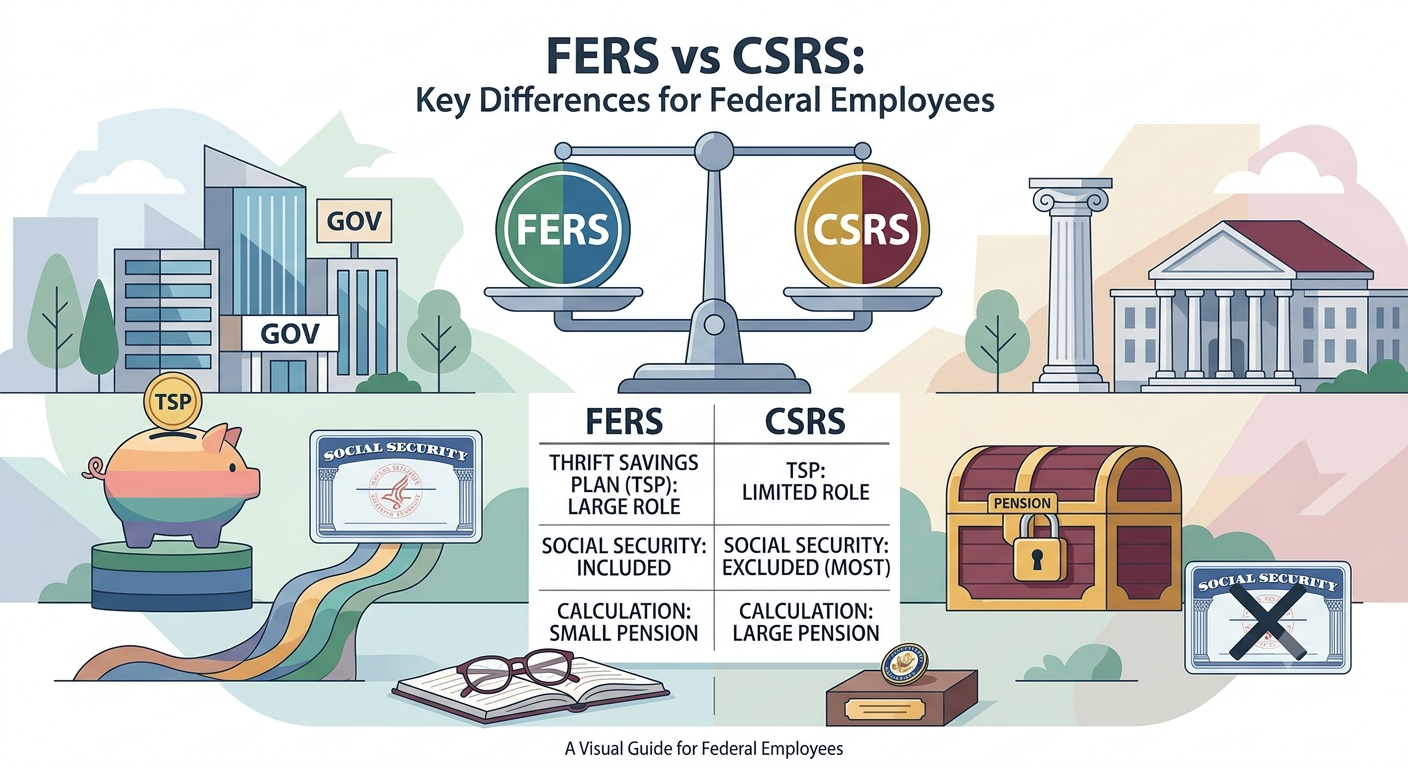
FERS vs CSRS: Side-by-Side Comparison
| Feature | CSRS | FERS |
|---|---|---|
| Who it covers | Employees hired before 1984 (with transition until 1987) | Employees hired 1984/1987 onward |
| Pension formula | Higher percentage per year of service | Lower percentage per year of service |
| Social Security | Not included (unless earned separately) | Included — employees pay into it |
| TSP | No employer matching | Employer matches up to 5% |
| Employee retirement contribution | Higher (typically 7-8% of salary) | Lower (typically 0.8%-4.4%, depending on hire date) |
| COLA (Cost of Living Adjustment) | Full COLA, tied to inflation | Reduced or delayed COLA (often 1% less than CSRS in high-inflation years) |
| Primary source of retirement income | The pension itself | Combination of pension + Social Security + TSP |
Key Difference #1: The Pension Formula
CSRS pensions were calculated with a formula that gives a higher percentage of salary per year of service — designed to fully replace a significant portion of income on its own, since there was no Social Security or matched TSP to supplement it.
FERS uses a smaller formula (generally 1% or 1.1% of your High-3 salary per year of service), precisely because it’s only one leg of the retirement «stool» — Social Security and TSP are expected to make up the difference.
In practice: a CSRS employee with 30 years of service will typically receive a noticeably higher pension percentage than a FERS employee with the same years of service — but the FERS employee also has Social Security and a TSP balance that the CSRS employee (in most cases) doesn’t.
Key Difference #2: Social Security
This is one of the most significant differences. CSRS employees generally do not pay into Social Security through their federal job, and therefore aren’t eligible for a Social Security benefit based on that employment (unless they’ve earned enough credits through other, non-federal work).
FERS employees pay into Social Security just like most private-sector workers, meaning their retirement income is diversified across three sources instead of one.
Key Difference #3: The TSP and Employer Matching
Both CSRS and FERS employees can contribute to the TSP — but only FERS employees receive employer-matching contributions (up to 5% of salary, if they contribute at least 5% themselves). For CSRS employees, the TSP is purely a personal savings vehicle without the «free money» matching component.
This is one of the clearest financial advantages built into FERS: over a 20-30 year career, employer matching alone can add up to a substantial six-figure difference in TSP balance at retirement.
Key Difference #4: Employee Contribution Rates
CSRS employees historically contribute a larger percentage of their salary (around 7-8%) toward their retirement system, since the pension is designed to be more generous and self-sufficient.
FERS employees contribute a smaller percentage toward the Basic Annuity (as low as 0.8% for employees hired before 2013, though this increased for those hired more recently — we cover the exact rates by hire date in a separate guide). The rest of a FERS employee’s retirement savings comes from voluntary TSP contributions.
Key Difference #5: Cost of Living Adjustments (COLA)
CSRS retirees receive the full COLA each year, matching the official inflation adjustment. FERS retirees, however, typically receive a reduced COLA — often 1 percentage point less than CSRS when inflation is above 2%, and no COLA at all before age 62 in most cases (except for disability retirees and a few special categories).
Over a long retirement, this difference in COLA treatment can meaningfully affect how well a pension keeps pace with rising costs — something FERS retirees often offset with TSP withdrawals and Social Security’s own COLA adjustments.
Which System Is «Better»?
This is one of the most common questions federal employees ask, and the honest answer is: it depends on how you look at it.
- CSRS offers a simpler, more predictable pension that’s designed to stand largely on its own, with full COLA protection — but no Social Security and no TSP matching.
- FERS offers a smaller basic pension, but diversifies retirement income across three sources (pension, Social Security, and a matched TSP), which for many employees results in comparable — or even higher — total retirement income, especially when the TSP is managed well over a long career.
Since virtually no one hired today has a choice between the two (CSRS has been closed to new employees since 1987), this comparison is mostly useful for understanding why your specific benefits look the way they do, or for household planning if you’re married to someone under the other system.
Is There a «CSRS Offset»?
Yes — worth a quick mention. CSRS Offset is a hybrid category that applies to some employees who had a break in federal service and were rehired after 1983. These employees are under CSRS rules but also pay into Social Security, with their CSRS pension «offset» (reduced) by an amount related to their Social Security benefit. If this applies to you, it’s worth getting a personalized explanation from your HR office, since the calculation differs from both standard CSRS and standard FERS.
Frequently Asked Questions
Can I switch from CSRS to FERS? Yes, current CSRS employees were given windows to voluntarily switch to FERS in the past (most notably in 1987 and 1998), and in some cases can still elect to switch. This is a significant financial decision that depends heavily on years remaining until retirement — consult your HR office or a federal benefits advisor before making this choice.
Do CSRS employees get Medicare? Yes — Medicare eligibility is separate from Social Security retirement benefits and applies to CSRS employees the same way it does to everyone else, based on age and Medicare-specific work credits.
Is CSRS still available for new federal employees? No. CSRS has been closed to new hires since 1987. Nearly all federal employees today are under FERS.
What’s Next
Now that you understand how FERS compares to its predecessor, the next logical step is to go deeper into how your own FERS pension is actually calculated:
- [How Is Your FERS Pension Calculated? Formula Explained] — see the exact formula and real examples.
- [Minimum Retirement Age (MRA) for FERS: Full Chart by Birth Year] — find out exactly when you become eligible to retire.
- [TSP Explained: The Federal Employee’s 401(k) Alternative] — understand the leg of your retirement that’s fully in your control.
Disclaimer: This article is for informational purposes only and does not